Sales Funnel Optimization Tactics That Turn More Visitors Into Customers
Sales Funnel Optimization Tactics That Turn More Visitors Into Customers
Reading time: 14 minutes
Ever watched your analytics dashboard light up with thousands of visitors — only to see your conversion rate hover somewhere between “disappointing” and “inexplicable”? You’re not alone. In 2026, the average e-commerce conversion rate sits at just 2.9%, meaning roughly 97 out of every 100 people who visit your site leave without taking action. That’s not a traffic problem. That’s a funnel problem.
Here’s the straight talk: a leaky sales funnel is the single most expensive problem most businesses refuse to talk about. You can pour budget into paid ads, SEO, and influencer campaigns all you want — but if your funnel isn’t optimized, you’re filling a bucket with holes.
This guide is your practical roadmap to diagnosing, rebuilding, and optimizing every stage of your sales funnel — from the moment a stranger first discovers your brand to the second they hand over their credit card details. Whether you’re running a SaaS startup, an e-commerce store, or a service-based business, the principles here translate directly into revenue.
Table of Contents
- What Is a Sales Funnel (And Why Most Are Broken)
- Top of Funnel: Attracting the Right Visitors
- Middle of Funnel: Nurturing and Building Trust
- Bottom of Funnel: Converting Intent Into Action
- Tools and Metrics That Matter in 2026
- Real-World Case Studies
- Frequently Asked Questions
- Your Funnel Optimization Action Plan
What Is a Sales Funnel (And Why Most Are Broken)
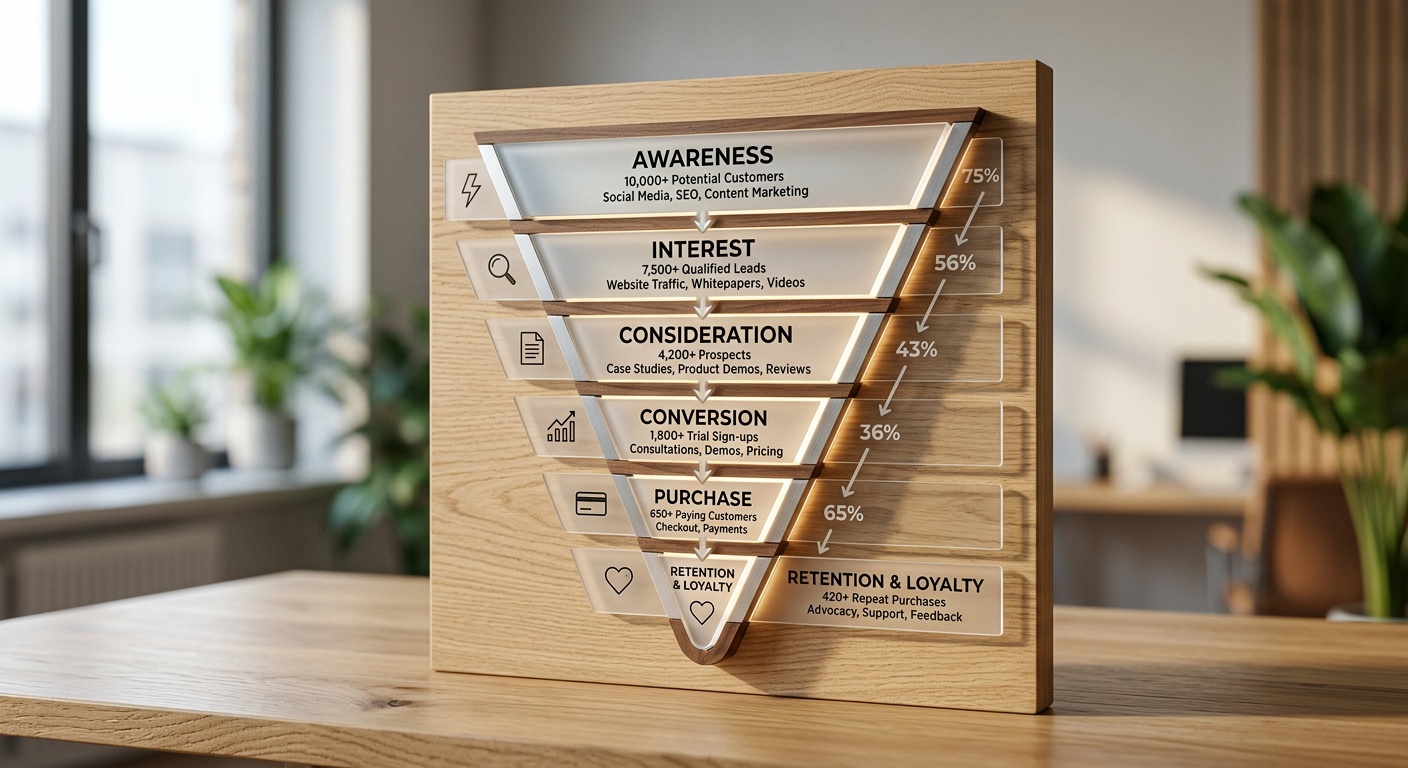
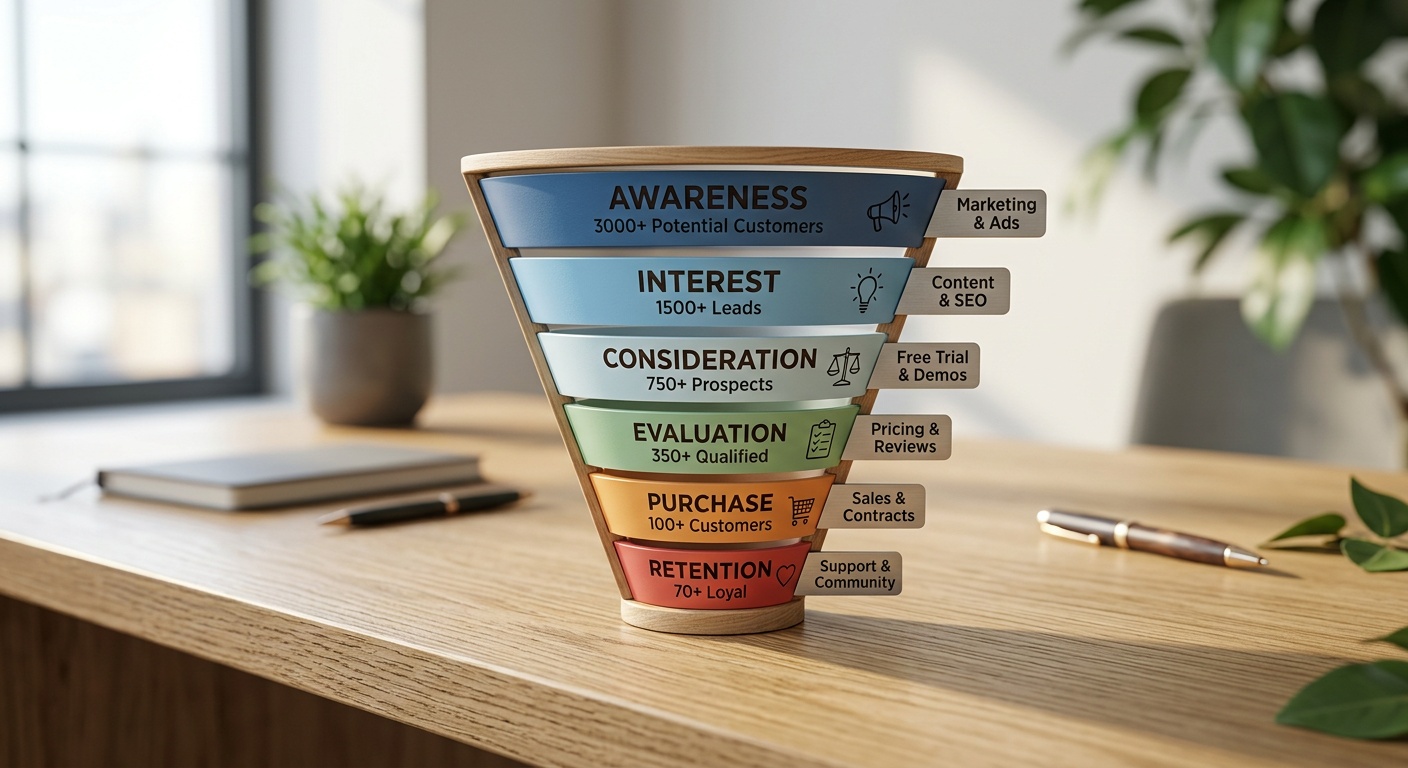
A sales funnel is the structured journey a prospect takes from first becoming aware of your brand to making a purchase — and ideally, becoming a repeat customer. The term “funnel” exists because the number of people narrows at each stage: many visitors, fewer leads, even fewer buyers.
The classic funnel model has three key zones:
- Top of Funnel (TOFU): Awareness — people discover you exist
- Middle of Funnel (MOFU): Consideration — people evaluate whether you’re the right fit
- Bottom of Funnel (BOFU): Decision — people are ready to buy and need one last push
So why are most funnels broken? Because businesses treat them like a linear slide rather than an active system that requires constant optimization. They set it up once, assume it works, and only notice the problem when revenue stalls. According to a 2025 HubSpot State of Marketing report, 68% of businesses have not formally identified their sales funnel stages — which means they’re flying blind when it comes to knowing where prospects drop off.
The modern funnel in 2026 is also non-linear. Customers might discover you on a TikTok short, research you on Reddit, read your blog three weeks later, get retargeted on Instagram, and then convert via a Google search. Your funnel needs to account for this fractured, multi-touchpoint reality.
“The biggest mistake I see brands make is optimizing for traffic when their actual constraint is conversion. More visitors into a broken funnel just means more wasted ad spend.” — Peep Laja, CXL Institute Founder
Top of Funnel: Attracting the Right Visitors
Here’s a counterintuitive truth about TOFU: more traffic isn’t always better. Attracting the wrong visitors — people who were never going to convert — inflates your bounce rate, skews your data, and wastes your retargeting budget. The goal at this stage isn’t volume. It’s qualified volume.
Defining Your Ideal Traffic Profile
Before you spend a single dollar on traffic acquisition, you need to know exactly who you’re trying to attract. This means going beyond basic demographics and building what marketers call an Ideal Customer Profile (ICP). An effective ICP for 2026 includes:
- Pain points — What problem are they actively trying to solve right now?
- Trigger events — What happened in their life or business that made them search for your solution?
- Information channels — Where do they actually consume content (Reddit, YouTube, LinkedIn, newsletters)?
- Decision criteria — What factors matter most to them when evaluating solutions?
Quick Scenario: Imagine you sell project management software for remote creative agencies. A broad content strategy targeting “productivity tips” will attract a wildly mixed audience. But content targeting “how to manage client revisions across time zones” immediately self-selects for exactly the right visitor — someone experiencing the exact pain your product solves.
TOFU Content Tactics That Actually Work in 2026
The content landscape has shifted dramatically. With AI-generated content flooding every niche, the bar for organic visibility has risen sharply. Search engines in 2026 prioritize genuine expertise, original data, and demonstrable experience — what Google’s quality guidelines now call E-E-A-T (Experience, Expertise, Authoritativeness, Trustworthiness).
Tactics that are delivering strong TOFU results right now:
- Original research and data studies — Proprietary data is link bait gold. A single well-promoted industry survey can generate hundreds of backlinks and significant organic traffic for years.
- Short-form video with text redirects — YouTube Shorts and TikTok continue to dominate discovery in 2026, but the key is creating a bridge from the video to a longer-form asset (article, guide, tool) on your own platform.
- Community-led SEO — Participating authentically in Reddit threads, Quora answers, and niche Discord servers builds brand awareness and earns qualified referral traffic that already trusts you.
- AI-assisted personalization at scale — Brands using AI to serve different homepage headlines, blog intros, or ad copy based on visitor segments are seeing up to 34% higher engagement at the top of funnel (Salesforce State of Marketing, 2025).
Pro Tip: Use UTM parameters on every traffic source so you can trace not just which channels drive visitors, but which channels drive converting visitors. There’s often a significant gap between the two.
Middle of Funnel: Nurturing and Building Trust
The middle of the funnel is where most businesses hemorrhage potential revenue without realizing it. A prospect has shown interest — they signed up for your newsletter, downloaded a resource, or spent 8 minutes reading your pricing page. They’re curious. But they’re not convinced yet.
In 2026, the average B2B buying cycle has lengthened to 6.2 months (Forrester, 2025), and B2C consumers now interact with an average of 9.5 touchpoints before converting. This means the MOFU stage isn’t a brief courtship — it’s a sustained relationship-building exercise.
Email Nurture Sequences That Don’t Get Ignored
Email remains the highest-ROI channel in the marketing stack — delivering an average return of $36 for every $1 spent according to the Data & Marketing Association’s 2025 benchmarks. But that ROI only materializes when your sequences are intelligent, not just automated.
The anatomy of a high-converting nurture sequence in 2026:
- Email 1 (Immediate): Deliver the promised value immediately, with zero selling. Just be helpful.
- Email 2 (Day 2-3): Address the #1 objection your prospects have — head on, with honesty.
- Email 3 (Day 5-7): Share a relevant case study or customer story. Let someone else make the case for you.
- Email 4 (Day 10): Provide a comparative framework that positions your solution without being overly promotional.
- Email 5 (Day 14): Soft call-to-action with a low-commitment next step (free trial, demo, consultation).
Critical detail most brands miss: segment your sequences by how someone entered your funnel. Someone who downloaded a “beginner’s guide” has completely different needs than someone who visited your enterprise pricing page three times. One-size-fits-all nurture sequences are conversion killers.
Social Proof Architecture: Beyond Basic Testimonials
Trust is the currency of the MOFU stage. In a 2025 Edelman Trust Barometer study, 81% of consumers said trust in a brand is a deal-breaker or deciding factor in their purchase decision. But slapping a few five-star reviews on your homepage isn’t a trust strategy — it’s a checkbox.
Build what we call a Social Proof Architecture — a deliberate system of credibility signals deployed at exactly the right moments in the funnel:
- Specificity wins over superlatives: “Reduced our client acquisition cost by 43% in 90 days” outperforms “Amazing service, highly recommend!” every single time.
- Match proof to objection: Place testimonials addressing price concerns near your pricing page. Place case studies about implementation ease near your onboarding section.
- Video testimonials at decision points: A 60-second genuine customer video can increase conversion rates by up to 80% at key decision points (Wyzowl, 2025).
- Third-party validation: Review platform widgets (G2, Trustpilot, Capterra), industry awards, and media mentions carry more weight than self-reported claims.
- Peer validation via community: Showcasing an active user community (Discord, Slack group, forum) signals that real people find ongoing value in what you offer.
Bottom of Funnel: Converting Intent Into Action
At the bottom of the funnel, your prospect knows what you offer, broadly trusts you, and is actively considering a purchase. This is the highest-leverage stage of the entire funnel — small optimizations here have outsized revenue impact. Yet this is also the stage where the most avoidable friction typically exists.
Think of BOFU optimization as removing the final 3% of doubt that’s preventing a “yes.”
Conversion Rate Optimization (CRO) Essentials
CRO isn’t about manipulating people into buying things they don’t want. It’s about ensuring that people who do want what you offer aren’t stopped by poor design, confusing copy, or unnecessary friction. Here’s where to focus:
1. Reduce cognitive load on key pages. Every extra element on your checkout page, demo request form, or pricing page is a decision your prospect has to make. Simplify ruthlessly. Amazon’s one-click purchase model isn’t just convenient — it’s a BOFU masterclass.
2. Address last-minute objections proactively. Add an FAQ section near your CTA buttons that answers the specific questions people ask your sales team most often. This pre-empts the hesitation that kills conversions.
3. Use urgency ethically. Fake countdown timers and manufactured scarcity destroy trust the moment prospects figure it out — and they always do. Instead, create genuine urgency: limited onboarding slots, actual seasonal pricing, or cohort-based program starts.
4. Optimize your checkout flow. According to Baymard Institute’s 2025 research, the average documented cart abandonment rate is 70.19%. The top reasons: unexpected costs (shipping, taxes), forced account creation, and complicated checkout processes. Fix these three and you’ll recover significant lost revenue immediately.
5. Implement exit-intent interventions. When a visitor moves to leave your pricing or checkout page, a well-timed exit-intent popup offering a discount, a free trial extension, or a “talk to a human” option can recover 5-10% of otherwise lost conversions.
Retargeting: Closing the Loop on Warm Prospects
Most BOFU visitors don’t convert on their first visit — and that’s fine, as long as you have a retargeting system to bring them back. In 2026, with continued third-party cookie deprecation across major browsers, effective retargeting requires a first-party data strategy.
Build your retargeting foundation on:
- Email retargeting to subscribers who visited high-intent pages (pricing, demo, checkout) but didn’t convert
- Hashed customer lists uploaded to Meta and Google for matched audience targeting
- On-site behavioral triggers that fire personalized messages based on specific page interactions
Tools and Metrics That Matter in 2026
You can’t optimize what you can’t measure. Here’s a comparative overview of the most critical funnel metrics and what benchmarks to aim for:
| Funnel Stage | Key Metric | Industry Average | Top Performer | Optimization Priority |
|---|---|---|---|---|
| TOFU | Click-Through Rate (CTR) | 2.1% | 5.5%+ | Ad copy, headline testing |
| TOFU → MOFU | Lead Capture Rate | 1.9% | 6.0%+ | Lead magnet value, form UX |
| MOFU | Email Open Rate | 21.5% | 40%+ | Subject lines, segmentation |
| BOFU | Checkout Completion Rate | 29.8% | 60%+ | Friction reduction, trust signals |
| Overall | Visitor-to-Customer Rate | 2.9% | 8-12% | Full-funnel alignment |
Beyond metrics, your tool stack should cover four categories: analytics (Google Analytics 4, Mixpanel), session recording & heatmaps (Hotjar, Microsoft Clarity), A/B testing (VWO, Optimizely), and CRM + automation (HubSpot, Klaviyo for e-commerce). In 2026, AI-powered funnel intelligence tools like Mutiny and Intellimize are becoming mainstream for mid-market brands, enabling real-time personalization that previously required enterprise-level budgets.
Conversion Rate by Traffic Source — 2026 Benchmarks
4.24%
3.10%
2.59%
1.39%
0.99%
Source: Aggregate 2026 industry benchmarks, e-commerce sector average
Real-World Case Studies
Case Study 1: SaaS Brand Reduces Churn Funnel by 61%
A mid-sized project management SaaS company (annual revenue ~$8M) noticed their free-trial-to-paid conversion rate had stagnated at 11% for two consecutive quarters in 2025. Rather than investing in more top-of-funnel traffic, they conducted a funnel audit and discovered the core problem: 74% of trial users never completed the onboarding flow and never experienced the product’s core “aha moment” — which was collaborative task assignment.
Their optimization strategy:
- Rebuilt the onboarding sequence around a single activation milestone (inviting a collaborator) rather than a feature tour
- Implemented a behavioral email trigger that fired after 48 hours if a user hadn’t invited a teammate, offering a 15-minute live setup call
- Added social proof (“Teams at Shopify and Canva use this workflow”) at the activation step
The result: Free-trial-to-paid conversion improved from 11% to 17.7% within 90 days — a 61% relative improvement — without any additional traffic spend. That single funnel fix added approximately $1.4M in annual recurring revenue.
Case Study 2: E-commerce Brand Recovers $380K in Abandoned Carts
A direct-to-consumer home goods brand was generating strong TOFU results — over 85,000 monthly sessions — but their checkout completion rate was 22%, well below the industry average. A Hotjar session recording analysis revealed three friction points killing conversions: a mandatory account creation step, surprise shipping costs appearing only at checkout, and a checkout page that felt visually cluttered and untrustworthy on mobile.
Their three-fix intervention:
- Enabled guest checkout with an optional post-purchase account creation prompt
- Displayed shipping costs (and a free shipping threshold) on product pages and in the cart
- Rebuilt the mobile checkout as a clean, single-column flow with prominent trust badges and a visible security seal
Within 60 days, checkout completion improved to 34.5% — a 57% increase. Combined with a three-email abandoned cart sequence (sent at 1 hour, 24 hours, and 72 hours post-abandonment), the brand recovered an estimated $380,000 in previously lost revenue over six months.
Frequently Asked Questions
How long does it take to see results from funnel optimization?
It depends heavily on your traffic volume and which stage you’re optimizing. BOFU optimizations — like checkout friction removal or exit-intent offers — can show measurable results within 2-4 weeks if you have sufficient traffic for statistical significance. MOFU improvements, particularly in email sequences and nurture flows, typically take 4-8 weeks to fully evaluate given the length of nurture cycles. TOFU content investments like SEO and organic social often take 3-6 months to compound meaningfully. The smartest approach is to start with BOFU (highest leverage, fastest results) and work backward through the funnel.
What’s the most common mistake businesses make when optimizing their sales funnel?
The single most common mistake is optimizing in isolation — improving one stage without considering how it connects to the others. For example, a brand might dramatically increase their email open rates by using clickbait subject lines, only to discover that higher open rates don’t translate to conversions because the email content doesn’t deliver on the subject line’s promise. Funnel optimization requires a systems perspective: every change you make in one stage affects the stages downstream. Always define your success metrics end-to-end (visitor-to-customer rate, revenue per visitor) rather than optimizing stage metrics in isolation.
How do I prioritize which part of my funnel to optimize first?
Use what’s called the “ICE” framework — Impact, Confidence, Ease — to score and prioritize potential optimizations. For each change you’re considering, rate it from 1-10 on: how much impact will it have on revenue if successful? How confident are you it will work based on data? How easy is it to implement? Multiply the three scores and tackle highest-scoring items first. In most cases, you’ll find that BOFU optimizations score highest because they convert people who are already warm, the data to identify problems (session recordings, heatmaps, checkout analytics) is readily available, and changes are often relatively simple to implement.
Your Funnel Optimization Action Plan: Start This Week
Here’s the reality: most businesses reading this guide will find it valuable, close the tab, and make exactly zero changes. Don’t be that business. The difference between brands that dominate their market in 2026 and those that struggle isn’t information — it’s execution velocity.
Here are your five concrete next steps, ordered by priority:
- Audit your current funnel this week. Map out every stage, identify where the biggest drop-offs occur, and assign a measurable metric to each stage. You cannot fix what you haven’t diagnosed.
- Install a session recording tool immediately. Microsoft Clarity is free. Hotjar has a generous free tier. Within 72 hours of watching real user sessions, you will identify friction points you never knew existed.
- Fix your single biggest BOFU leak first. Is it cart abandonment? Form friction? Lack of trust signals? Pick the one thing costing you the most money right now and fix it before anything else.
- Build a proper email nurture sequence for your most important lead segment. Even a 3-email sequence — deliver value, address objection, soft CTA — is dramatically better than no sequence at all.
- Set a 90-day optimization cadence. Schedule monthly funnel reviews, track your metrics in a simple dashboard, and run at least one A/B test per month. Optimization is a discipline, not a project.
The broader implication here is significant: as AI continues to commoditize content creation and lower the barrier to entry in virtually every market, the brands that win in 2027 and beyond will be the ones who understand their customers most deeply — and who’ve built funnels that reflect that understanding at every touchpoint.
Here’s the question worth sitting with: If you looked at your funnel through your customer’s eyes right now — at every stage, every email, every checkout step — would you feel confident, or would you feel friction? Your honest answer to that question is the most valuable funnel insight you’ll find today.